Call Technician

Sanyo AC Error Code List& Troubleshooting Guide [Checklist]
Sanyo AC error codes explained with LED signals, causes & quick fixes. Know when to call a technician for split & window AC. Read the full guide now.
TL;DR: Common Causes of Sanyo AC Error Codes
Sanyo AC Error Code Lookup
Type your error code below to see what it means and the quick fix to try.
Quick Find Your Sanyo AC Error Codes (Dpwnload PDF)
Sanyo Split and Window ACs display faults using LED blink patterns, along with dual-digit codes on some models. Match your error code and LED signal below to understand the issue and try a quick fix before calling a technician.
| Error Codes & Meaning | Quick Solutions |
|---|---|
| EE – Indoor PCB malfunction | Replace indoor main board |
| E2 – Anti-freezing protection (evaporator freezing) | Check for dirty filter or blocked coil |
| H4 – System overload | Check if evaporator/condenser is dirty or blocked |
| H6 – No feedback from indoor fan motor | Check if fan motor is mounted properly |
| F2 – Indoor pipe (coil) temperature sensor fault | Check connection; measure resistance with multimeter |
| F1 – Internal ambient temperature sensor fault | Check connection; measure resistance with multimeter |
| UF – Overload of compressor | Check overload wire and compressor resistance to ground |
| H3 – Zero passage (zero-crossing) abnormal | Replace indoor main board |
| LC – Startup failure | Check compressor wiring; wait 3 minutes before restart |
| UH – No feedback from outdoor fan motor | Check outdoor fan wiring and connections |
| E5 – Compressor over current protection | Check compressor resistance and resistance to ground |
| U7 – 4-way valve conversion abnormal | Replace 4-way valve |
| U1 – Phase current detection malfunction (compressor) | Check compressor resistance to ground; may need outdoor main board replacement |
| H7 – Sync failure (compressor losing sync) | Check electric network stability; replace outdoor main board if needed |
| U5 – Current detection malfunction (complete unit) | Replace outdoor main board |
| F3 – Outdoor ambient temperature sensor fault | Check connection; measure resistance with multimeter |
| F4 – Discharge protection of compressor | Check connection; measure resistance with multimeter |
| F5 – Break-circuit/short-circuit, outdoor discharge temp sensor | Check connection; measure resistance with multimeter |
| P8 – Break-circuit/short-circuit, outdoor condenser temp sensor | Check outdoor ambient temperature and radiator mounting |
| UU – Overheat of carbon fin | Check if radiator is mounted correctly |
| P7 – DC over current | Replace outdoor main board |
| F0 – Temperature sensor malfunction (carbon fin) | Check connection; measure resistance with multimeter |
| PH – Lack of Freon (refrigerant) or block protection | Check refrigerant gas level and blockages |
| PL – DC input voltage too high | Check AC power supply voltage |
| E6 – DC input voltage too low | Check AC power supply voltage |
| UA – Communication malfunction | Check outdoor connecting wire connection |
| Setting error – Indoor and outdoor unit mismatch | Confirm indoor and outdoor units are a matched pair |
Hire Our Expert AC Technician for Same Day Home Service in Kolkata
Sanyo Split and Window ACs display error codes to alert users about faults in sensors, PCB, compressor, or fan motors. Some codes indicate genuine faults, while others are protection codes, safety shutdowns triggered by conditions like high voltage, low refrigerant, or overheating rather than actual part failure.
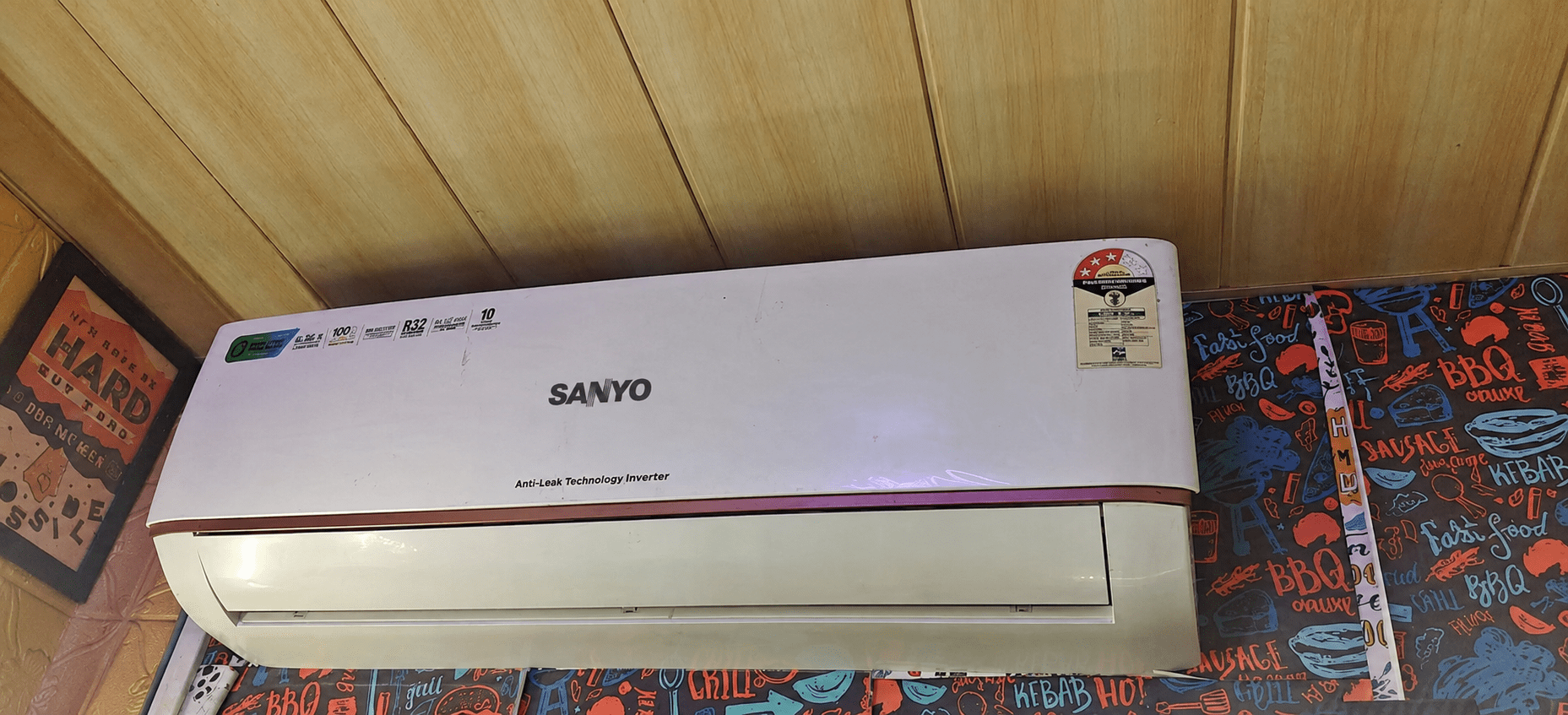
This guide covers Sanyo DC Inverter Split AC models (SAP-KRV9AEH, SAP-KRV12AEH) and Window AC units, helping you read LED blink patterns and dual-digit display codes correctly.
Based on official Sanyo technical and service manuals, this guide is designed for Indian AC users who want quick, reliable troubleshooting before booking a professional repair visit.

Sanyo AC Error Code Explanation With Possible Solutions
EE – Indoor PCB Malfunction
LED Display: Heating LED pauses for 3 seconds and blinks 15 times
- What Causes This Error: A general fault on the indoor PCB (printed circuit board) is triggering this code, often due to component damage or a firmware issue.
- How to Fix The Error: Replace the indoor main board, since the manual lists board replacement as the direct repair method for this code.
E2 – Anti-Freezing Protection
LED Display: Running LED pauses for 3 seconds and blinks 2 times
- What Causes This Error: The system activates this protection when the evaporator coil temperature drops too low, usually from a dirty filter, blocked airflow, or low refrigerant.
- How to Fix The Error: Clean or replace the air filter and check the coil for blockages; if the coil is still icing up, call a technician to check refrigerant levels.
Connect with Urban Service Plaza for a same day AC repair service in Kolkata & nearby areas. We do repair service and installation of all out of warranty AC brands including Sanyo at customers doorstep.
H4 – System Overload Protection
LED Display: Heating LED pauses for 3 seconds and blinks 4 times
- What Causes This Error: The AC has detected abnormal system load, which the manual links to a dirty or blocked evaporator and condenser coil.
- How to Fix The Error: Inspect and clean both indoor and outdoor coils to restore normal airflow and heat exchange.
H6 – Indoor Fan Motor Feedback Error
LED Display: Running LED pauses for 3 seconds and blinks 11 times
- What Causes This Error: The main board is not receiving a feedback signal from the indoor fan motor, which can happen if the motor is loose or not mounted properly.
- How to Fix The Error: Check that the electromotor (fan motor) is mounted correctly and securely connected.
F2 – Indoor Pipe Temperature Sensor Malfunction
LED Display: Cooling LED pauses for 3 seconds and blinks 2 times
- What Causes This Error: The indoor coil (pipe) temperature sensor connection may be loose, or the sensor itself may have failed.
- How to Fix The Error: Check if the sensor connection is loose, then measure its resistance value with a multimeter to confirm if it needs replacing.
F1 – Indoor Ambient Temperature Sensor Malfunction
LED Display: Cooling LED pauses for 3 seconds and blinks 1 time
- What Causes This Error: This code appears when the internal (room) ambient temperature sensor connection is loose or the sensor is faulty.
- How to Fix The Error: Check if the sensor connection is loose, then measure resistance with a multimeter to determine if sensor replacement is needed.
UF – Zero Crossing Detection Abnormal
LED Display: Heating and Cooling LEDs blink 7 times simultaneously
- What Causes This Error: The unit fails to detect the zero-crossing point of the AC power signal correctly, often linked to overload of the compressor.
- How to Fix The Error: Inspect the overload wire connection and check compressor resistance and resistance to ground; if the compressor is normal, the outdoor main board may be faulty.
H3 – Compressor Overload Protection
LED Display: Heating LED pauses for 3 seconds and blinks 3 times
- What Causes This Error: The compressor has drawn excess load, which the manual notes may happen specifically when an outdoor DC electromotor is used.
- How to Fix The Error: Replace the indoor main board, as listed for this code, and verify the outdoor DC motor is functioning correctly.
LC – Compressor Start-up Failure
LED Display: Heating LED pauses for 3 seconds and blinks 11 times
- What Causes This Error: The compressor fails to start, which may be due to incorrect wiring or insufficient rest time between cycles.
- How to Fix The Error: Confirm the compressor wiring matches the line chart and ensure the compressor has stopped for at least 3 minutes before restarting.
UH – Outdoor Fan Motor Feedback Error
LED Display: Heating and Cooling LEDs blink 8 times simultaneously
- What Causes This Error: The main board is not receiving feedback from the outdoor fan motor, similar to the indoor fan feedback fault but on the outdoor unit.
- How to Fix The Error: Check if the electric network is variable, and inspect the outdoor fan motor wiring and connections.
E5 – Over Current Protection
LED Display: Running LED pauses for 3 seconds and blinks 5 times
- What Causes This Error: The compressor or system has drawn current beyond the safe limit, triggering a protective shutdown.
- How to Fix The Error: Replace the 4-way valve as indicated, and check compressor resistance and resistance to ground to rule out compressor damage.
U7 – 4-Way Valve Switching Abnormal
LED Display: Cooling LED pauses for 3 seconds and blinks 20 times
- What Causes This Error: The 4-way valve, which switches the AC between cooling and heating modes, is not converting properly.
- How to Fix The Error: Check compressor resistance and resistance to ground; if the compressor tests normal, the outdoor main board likely needs replacement.
U1 – Compressor Phase Current Detection Malfunction
LED Display: Heating LED pauses for 3 seconds and blinks 13 times
- What Causes This Error: The system cannot correctly detect the phase current of the compressor, which may point to a wiring or board-level issue.
- How to Fix The Error: Replace the outdoor main board, as specified in the manual for this fault code.
H7 – Compressor Synchronization (Sync) Failure
LED Display: Heating LED pauses for 3 seconds and blinks 7 times
- What Causes This Error: The compressor loses synchronization, which can happen at startup or during running due to high system pressure, low voltage, poor wiring, or a blocked outdoor fan.
- How to Fix The Error: Check the compressor and fan wiring connections, clear any obstruction from the outdoor fan, and replace the compressor or outdoor electric box parts if the fault continues.
U5 – Current Detection Malfunction of Complete Unit
LED Display: Cooling LED pauses for 3 seconds and blinks 13 times
- What Causes This Error: The unit cannot accurately detect current across the complete system, indicating a possible fault in the outdoor main board.
- How to Fix The Error: Replace the outdoor main board, as this is the direct repair method listed in the manual.
F3 – Outdoor Ambient Temperature Sensor Malfunction
LED Display: Cooling LED pauses for 3 seconds and blinks 3 times
- What Causes This Error: The outdoor unit’s ambient temperature sensor connection is loose, or the sensor itself has failed.
- How to Fix The Error: Check if the connection is loose, then measure the sensor’s resistance value with a multimeter to confirm the fault.
F4 – Compressor Discharge Temperature Protection
LED Display: Running LED pauses for 3 seconds and blinks 4 times
- What Causes This Error: The compressor’s discharge (exhaust) temperature has exceeded the safe operating range.
- How to Fix The Error: Check if the sensor connection is loose and measure resistance with a multimeter to verify the discharge sensor is working correctly.
F5 – Outdoor Discharge Temperature Sensor Open/Short Circuit
LED Display: Cooling LED pauses for 3 seconds and blinks 5 times
- What Causes This Error: The outdoor discharge temperature sensor wiring has an open or short circuit, preventing accurate temperature readings.
- How to Fix The Error: Check if the connection is loose, then measure resistance with a multimeter to confirm if the sensor needs replacing.
P8 – Outdoor Heat Sink (Carbon Fin) Overheat Protection
LED Display: Heating LED pauses for 3 seconds and blinks 19 times
- What Causes This Error: The outdoor heat sink (carbon fin) has overheated, often due to high outdoor ambient temperature or a poorly mounted radiator.
- How to Fix The Error: Check if the outdoor ambient temperature is too high and confirm the radiator is mounted correctly for proper heat dissipation.
We are not authorized Sanyo AC service centre in Kolkata. Contact only for out of warranty appliance repair.
UU – DC Over Current Protection
LED Display: Heating and Cooling LEDs blink 11 times simultaneously
- What Causes This Error: The DC circuit has drawn current beyond the safe threshold, triggering a protective shutdown.
- How to Fix The Error: Replace the outdoor main board, as listed for this protection code.
P7 – Heat Sink Temperature Sensor Malfunction
LED Display: Heating LED pauses for 3 seconds and blinks 18 times
- What Causes This Error: The temperature sensor monitoring the heat sink (carbon fin) has a loose connection or has failed.
- How to Fix The Error: Check if the connection is loose, then measure resistance with a multimeter to confirm if the sensor needs replacing.
F0 – Refrigerant Shortage / System Blockage Protection
LED Display: Cooling LED pauses for 3 seconds and blinks 10 times
- What Causes This Error: This code signals a lack of refrigerant (Freon) or a blockage somewhere in the refrigerant circuit.
- How to Fix The Error: Have a technician check refrigerant levels and inspect the system for blockages, then recharge gas or clear the block as needed.
PH – DC Input Voltage Too High
LED Display: Cooling LED pauses for 3 seconds and blinks 11 times
- What Causes This Error: The DC input voltage supplying the unit is higher than the normal operating range.
- How to Fix The Error: Check if the AC power supply voltage is normal and correct any voltage fluctuation issues, using a stabilizer if needed.
PL – DC Input Voltage Too Low
LED Display: Heating LED pauses for 3 seconds and blinks 21 times
- What Causes This Error: The DC input voltage is lower than the required operating range for the unit.
- How to Fix The Error: Check if the AC power supply voltage is normal and address any low-voltage supply issues.
E6 – Communication Malfunction (Indoor ↔ Outdoor)
LED Display: Running LED pauses for 3 seconds and blinks 6 times
- What Causes This Error: The indoor and outdoor units are failing to communicate, usually because of a loose or damaged connecting wire.
- How to Fix The Error: Check if the outdoor connecting wire is reliably connected, and repair or replace the wiring if needed.
UA – Indoor & Outdoor Unit Mismatch (Setting Error)
LED Display: Heating and Cooling LEDs blink 12 times simultaneously
- What Causes This Error: This setting error occurs when the outdoor unit is not a matched pair with the indoor unit.
- How to Fix The Error: Confirm that the indoor and outdoor models are the correct matched combination as specified by Sanyo.
Find AC Error Codes & Troubleshooting of All Brands
Troubleshoot for Most Common Sanyo AC Problems
AC does not operate immediately after restarting
This is normal operation, not a fault. When the AC is switched off and restarted right away, the overload protection switch delays startup for 3 minutes to protect the compressor. Simply wait for 3 minutes before the unit starts running again; no repair is needed.
Unusual odor comes from the indoor unit
A strange smell after startup is often due to dust or buildup on the air filters. Clean the air filters first; if the odor continues, the unit needs servicing, so contact an authorised Sanyo maintenance centre.
Water flowing or gurgling sound is heard
This is a normal sound caused by refrigerant flowing through the system when the AC starts, stops, or when the compressor turns on or off. No action is needed, as this sound does not indicate a malfunction.
Mist comes out of the indoor unit
This happens when indoor temperature and humidity are high, causing the room air to cool down rapidly. Continue running the AC as usual; the mist will disappear once indoor temperature and humidity drop.
Creaking noise during startup or shutdown
This noise is caused by plastic parts expanding or contracting due to temperature changes. No repair is required, as this is a normal part of AC operation.
AC does not operate
This can happen if the power supply is off, the plug is loose, the voltage is too high or low, or the Timer ON function was accidentally activated. Check the power supply and plug connection, confirm the Timer ON setting, and if voltage seems abnormal, ask a qualified service technician to check it.
Cooling or heating performance is poor
Weak performance is usually linked to incorrect temperature settings, blocked vents, dirty filters, open doors or windows, low fan speed, or extra heat sources in the room. Check the temperature setting, clean the filters, close windows and doors, increase the fan speed, and remove heat sources near the unit.
Remote control does not work
Electrical interference can temporarily affect the remote, or there may be an obstacle between the remote and the indoor unit, or the batteries may be weak. Disconnect and reconnect the power supply to reset the system, remove obstacles, point the remote correctly at the receiver, and replace batteries if needed.
Water leaks from the indoor unit
High indoor humidity can cause excess condensation, or the drain pipe connection may have become loose. Check whether the drain pipe connection is loose and secure it; if leakage continues, professional inspection is advised. Read more about Water leaking from AC indoor units and solutions.
Water leaks from the outdoor unit
This is generally normal, as condensation forms on refrigerant pipes during Cooling mode, and melted frost drains out during Heating or Defrost mode. No action is needed in most cases, since this is part of normal operation.
Noise comes from the indoor unit
Switching sounds from the fan or compressor relay are normal, and refrigerant may flow in the opposite direction during defrosting or right after the compressor stops. No repair is required, as these are standard operating sounds.
Indoor unit does not blow air
During Heating mode, the indoor fan may pause to avoid blowing cold air, or the outdoor unit may enter defrost mode when frost builds up, stopping the indoor fan for about 3 to 12 minutes. In Dry mode, the fan may also stop occasionally to prevent moisture re-condensing. Allow the defrost or dry cycle to complete; this is normal and does not need repair.
Moisture forms on the indoor air outlet
Continuous operation in high humidity can cause moisture to condense on the air outlet grille. No repair is needed, as this condensation is normal and may drip occasionally from the grille.
When to Call Sanyo Service Centre for Technician Visit?
Sanyo AC error codes help you spot the exact fault quickly, whether it’s a sensor issue, PCB fault, or compressor problem.
Basic checks like cleaning filters and inspecting wiring can solve minor issues. However, for compressor, refrigerant, or PCB faults, always contact Urban Service Plaza or an authorised Sanyo service centre for safe, lasting repairs.